Showing posts with label commentary -- counter terrorism. Show all posts

Thursday, October 10, 2013

Why Are U.S. Drone Strikes Declining?

Drone Strikes Plummet As U.S. Seeks More Human Intelligence -- Washington Post

Terrorist captures can lead to high-value targets

The number of drone strikes approved by the Obama administration on suspected terrorists has fallen dramatically this year, as the war with al Qaeda increasingly shifts to Africa and U.S. intelligence craves more captures and interrogations of high-value targets.

U.S. officials told The Washington Times on Wednesday that the reasons for a shift in tactics are many — including that al Qaeda’s senior ranks were thinned out so much in 2011 and 2012 by an intense flurry of drone strikes, and that the terrorist network has adapted to try to evade some of Washington’s use of the strikes or to make them less politically palatable.

But the sources acknowledged that a growing desire to close a recent gap in actionable human intelligence on al Qaeda’s evolving operations also has renewed the administration’s interest in more clandestine commando raids like the one that netted a high-value terrorist suspect in Libya last weekend.

Read more ....

Update: Is the U.S. Officially Moving Away from Drone Strikes? -- Connor Simpson, The Atlantic

My Comment: This is a major shift in U.S. counter terrorism policy .... and I am sure that gathering intelligence is one of them.

Tuesday, October 8, 2013

U.S. Counter Terrorism Strategy Needs More Than Just The Navy SEALs

A U.S. soldier pulls security during a battle drill on Forward Operating Base Lightning in Paktia province, Afghanistan, Oct. 3, 2013. U.S. Army photo by Sgt. Justin A. Moeller

Navy SEALs Aren’t Enough To Win War On Terror -- Max Boot, New York Post

The paradox, and saving grace, of the Obama presidency is that while the president is indecisive about big things — the Afghan surge, intervention in Syria, entitlement reform, repealing the sequester, reopening the federal government, even the fast disappearing “Pacific pivot” — he is very decisive about ordering drone strikes and raids by Special Operations Forces (or SOF) on terrorist targets.

Indeed, Obama may well be the most SOF-friendly president we’ve ever had.

This weekend, acting on the president’s orders, Special Operations teams came ashore in both Somalia and Libya. In Libya, the operators captured Nazih Abdul-Hamed al-Ruqai, alias Abu Anas al-Liby, who is wanted for the bombing of two US embassies in Africa in 1998.

Read more ....

My Comment: The U.S. does need a different strategy to combat terrorism .... but I do not see it from this administration yet.

Tuesday, August 13, 2013

US Counter-Terrorism Strategy In Yemen Is To 'Bomb And Hope'

Throughout 2013, the US has launched 21 airstrikes in Yemen, the vast majority from drones. Photograph: Reuters

Barrage Of Drone Strikes In Yemen Show Flaws Of US Counter-Terrorism Strategy -- Spencer Ackerman, The Guardian

Four years after identifying al-Qaida in Yemen as a major terrorist threat, the US seems stuck with a plan of 'bombing and hoping'.

If the barrage of US drone strikes over the last week weakened al-Qaida's Yemen affiliate, the terrorist organization that has captured Washington's attention isn't acting like it. Not only is it vowing another attack, it has prompted the US to keep its Yemen embassy closed while reopening all the others – implicitly highlighting the weakness of the US policy of launching drone strikes first and asking questions later.

Intelligence chatter indicating an imminent attack by al-Qaida in the Arabian peninsula (Aqap) prompted two reactions by Washington. The first was to order a dramatic, temporary shutdown at embassies and consulates throughout the Middle East and Africa. The second was to order a surge in drone strikes in Yemen.

Read more ....

My Comment: I have been following the U.S. war against Al Qaeda for years .... and while in the past I could define what US counter-terrorism strategy was .... i.e. rendition/Guantanamo/interrogation and intelligence gathering/alliances/etc. .... I have trouble defining it accurately now .... but "bombing and hoping" is certainly one description that I would use.

Thursday, May 9, 2013

Is The White House Outsourcing It's Kill And Capture Operations Against Certain Terror Groups?

U.S. soldiers train their counterparts in Ghana, 2011. The next leader of U.S. Africa Command emphasized such training as a fixture for confronting terrorist groups in Africa. Photo: U.S. Army

Outsourcing Lethality -- Micah Zenko, Foreign Policy

When there's a foreign finger on the trigger, is Washington still accountable when innocents die?

"Outsourcing" is a dirty word in Washington these days. But officials are strangely silent when it involves targeted killings. This column has repeatedly focused on the scope, distinction, legality, and strategic effectiveness of America's Third War of non-battlefield targeted killings in Pakistan, Yemen, Somalia, and the Philippines. Among the most widely promulgated criticisms of U.S. drone strikes is the absence of any transparency in decision making, limited congressional and judicial oversight, and the potential for civilian harm without any apparent corrective action. Policymakers and analysts have offered suggestions for how -- over 10 years after they began -- the Obama administration could comprehensively reform its targeted killing policies. Finally, President Barack Obama and Attorney General Eric Holder promised some reforms related to transparency "in the months ahead." That was several months ago. Given the Obama administration's refusal to provide witnesses to recent congressional hearings on drones -- or answer clarifying questions posed by journalists and policymakers -- it is likely that forthcoming announcements will fall short of the president's repeated goal of making his, "the most transparent administration in history."

Read more ....

My Comment:
The U.S. outsources some of it's arms deals through third parties .... so why not outsource kill or capture squads. Not surprisingly .... there is zero debate in Congress on this policy, and little if any coverage in the main stream media.

Update: A special thanks to Instapundit for the link. For new visitors to this blog, War News Updates is always updated with a new post on the hour.

Saturday, March 16, 2013

How The United States Is Blowing The War On Terror In Waziristan

A map showing Pakistan's tribal areas, where the drone attacks have been concentrated. The Guardian

Wayward In Waziristan -- Akbar Ahmed And Harrison Akins, Foreign Affairs

How the United States is blowing the war on terror in the most dangerous place in the world.

It's possibly the most ominous-sounding region on the planet: Waziristan -- the name alone evokes al Qaeda, the Taliban, and Islamic militancy. These menaces have brought the world's focus to this small mountainous border region of northwest Pakistan, a part of the country's Federally Administered Tribal Areas, which U.S. President Barack Obama referred to as "the most dangerous place in the world."

The combined might of the U.S. and Pakistani militaries has been pounding on this impoverished region, which is about the size of Connecticut, for over a decade. Waziristan is the heart of the U.S. drone campaign in Pakistan: Out of 351 strikes, 333 of them have occurred there.

Read more ....

My Comment:
With no boots on the ground and zero influence there is no possibility of stopping these terror groups. And as to having their top leaders and commanders killed in drone strikes .... if recent reports of civilian casualties are true .... blow-back will probably be the end result of that strategy. I guess the best that we can do is to contain them in that part of Pakistan .... but with U.S. forces now leaving .... even that course of action is probably not going to happen.

Wednesday, March 13, 2013

Using Local Armies To Fight Against U.S. Enemies

Outsourcing the Fight Against Terrorism -- James Kitfield, National Journal

The United States is using local soldiers to fight al-Qaida allies in East Africa.

MANDA BAY NAVAL BASE, Kenya—The C-12 twin-engine turboprop drops through a break in the clouds, and Kenya’s tropical Lamu Archipelago, surrounded by coral-green waters, emerges like a lost continent. Cuticles of virgin white beach line a jungle that stretches back into the country’s interior. Banking, the pilot spots a short airstrip cut out of the foliage. The station below is one of the remotest outposts in an expanding U.S. network of staging bases in Africa. The clouds close when the rainy season arrives in mid-March, and Manda Bay can go for weeks, even months, without so much as a mail drop. The C-12 touches down on an unlit runway and stops.

Read more
....

My Comment: Historically speaking this is nothing new .... the Romans used local armies to fight their battles and to enforce their empire. The U.S. does not have an empire in East Africa, but there are Al Qaeda affiliated threats located in the region that can easily metastasized into something that can become a serious problem in the future. What better way to contend with them than by using local soldiers who are familiar with the culture and geography and will not be constrained by U.S. rules of engagement. The only drawback .... these local soldiers may operate under rules of engagement that are totally unacceptable to the U.S..

Friday, January 4, 2013

If You Are A Terrorist, This Is How The U.S. Determines Your Fate

How Obama Decides Your Fate If He Thinks You're a Terrorist -- Daniel Byman and Benjamin Wittes, The Atlantic

A look inside the "disposition matrix" that determines when -- or if -- the administration will pursue a suspected militant.

Over the past two years, the Obama administration has begun to formalize a so-called "disposition matrix" for suspected terrorists abroad: a continuously evolving database that spells out the intelligence on targets and various strategies, including contingencies, for handling them. Although the government has not spelled out the steps involved in deciding how to treat various terrorists, a look at U.S. actions in the past makes evident a rough decision tree.

Read more ....

My Comment: The complete flowchart that is used to determine the status of a terror suspect is here. It appears that #13 (lethal force) is the most popular one for this administration.

Monday, September 17, 2012

How America's War Against Terror Groups Is Undermining NATO

U.S. Tactics Threaten NATO -- Tom Parker, National Interest

A growing chasm in operational practice is opening up between the United States and its allies in NATO. This rift is putting the Atlantic alliance at risk. Yet no one in Washington seems to be paying attention.

The escalating use of unmanned aerial vehicles to strike terrorist suspects in an increasing number of operational environments from the Arabian Peninsula to Southeast Asia, coupled with the continued use of military commissions and indefinite detention, is driving a wedge between the United States and its allies.

Read more
....

My Comment:
If NATO has an alternative plan to the present operational war against Al Qaeda and it's affiliated .... I am all ears. But NATO does not, and the legal barriers that it is setting up will only benefit terror groups and their sympathizers.

Thursday, June 7, 2012

President Obama's 'Kill List'


Why Americans Love Obama’s Kill List -- Michael A. Cohen, Miami Herald

Last week, two blockbuster New York Times stories cast perhaps the most unfavorable light on President Obama’s foreign-policy performance since he took office. First, there was the revelation that Obama maintains a “kill list” of potential al Qaida targets and signs off personally on major drone strikes in the continuing global war on terror. While Obama’s involvement suggests a certain level of rigor in target selection, the article also highlighted the fact that the president is ordering military strikes, including against U.S. citizens, without any congressional or judicial oversight.

Next came the revelation that under Obama’s presidency the United States has not only continued but ramped up a de facto war with Iran, with cybertools intended to disrupt Iran’s efforts to create a nuclear weapon.

Read more ....

Commentary On President Obama's 'Kill List'

After Article on ‘Kill List,’ Rumors Fly Fast -- New York Times
Obama's 'kill list' -- Robert Grenier, Al Jazeera
Drone Worrier -- Mark Thompson, Time
Getting Them Dead -- Francine Prose, New York Review of Books
‘Kill list:’ how drone attacks turned Obama into a hardliner -- Al Arabiya
Praying at the Church of St Drone -- Tom Engelhardt, Al Jazeera
In constitutional republics, presidents don’t have ‘kill lists’ -- Doug Bandow, Daily Caller

My Comment: As you can tell by the above commentaries, some in the American left are finally reacting with muted horror to a policy that if it was implemented under someone like former President Bush .... their reaction would have been immediate and followed by non-stop condemnation (24/7) via through the media/academia/anti-war groups/Democrats/etc.. As to what's my take .... I lean towards John Woo's opinion piece in today's Wall Street Journal that points out the ironies that are involved as well as summing up what are (and will be) the consequences and short comings of pursuing such a policy. The link to his piece is here.

Friday, June 1, 2012

Barack Obama: Drone Warrior

President Obama in the Oval Office with Thomas E. Donilon, left, the national security adviser, and John O. Brennan, his top counterterrorism adviser. Pete Souza/The White House

Barack Obama: Drone Warrior -- Charles Krauthammer, Washington Post

A very strange story, that 6,000-word front-page New York Times piece on how, every Tuesday, Barack Obama shuffles “baseball cards” with the pictures and bios of suspected terrorists from around the world and chooses who shall die by drone strike. He even reserves for himself the decision of whether to proceed when the probability of killing family members or bystanders is significant.

The article could have been titled “Barack Obama: Drone Warrior.” Great detail on how Obama personally runs the assassination campaign. On-the-record quotes from the highest officials. This was no leak. This was a White House press release.

Read more ....

My Comment: Judge Andrew P. Napolitano adds to the conversation. What`s my take .... former US Defense Secretary Donald Rumsfeld has it right.

Monday, May 14, 2012

Doubts On The U.S. Counterterrorism Mission In Yemen Are Being Raised


American Drones Will Not Save Yemen -- Joshua Foust, The Atlantic

An attempted terrorist attack this week has been bookended by U.S. drone strikes in Yemen. Do we know they're effective?

The first half of May has seen significant levels of violence in Yemen. On May 3, a drone strike killed 13 suspected militants in southern Yemen. On May 6, a drone strike killed Fahd al-Quso, one of the al-Qaeda operatives behind the 2000 bombing of the USS Cole. On May 10, another drone strike killed 8 more suspected militants.

Read more
....

My Comment: Stories like this one reminds me of what former US Defense Secretary Rumsfeld once said .... are we eliminating Al Qaeda's forces faster than they can replenish their ranks. If the above post is to be believed .... the answer is no.

Thursday, February 16, 2012

American's Overwhelmingly Support Today's Counter-Terrorism Policies

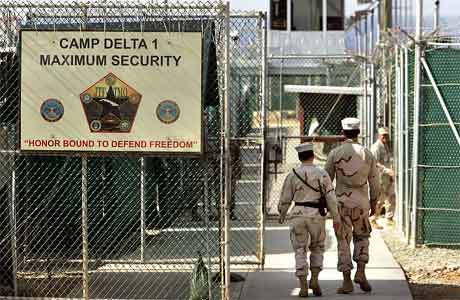
(Guantanamo Prison)

Legitimization Of Counterterrorism Policies -- Jack Goldsmith, Washington Post

A Washington Post/ABC News poll this month revealed extraordinary bipartisan support for President Obama’s counterterrorism policies. Seventy percent of respondents (including a majority of self-identified liberal Democrats) said they approve of keeping open the Guantanamo Bay detention facility, and 83 percent (including 77 percent of liberal Democrats) said they approve of Obama’s use of armed drone aircraft against terror suspects overseas. “It’s hard to imagine that Dems and liberals would approve of such policies in quite these numbers if they had been authored by George W. Bush,” noted The Post’s Greg Sargent.

Read more
....

My Comment: Jack Goldsmith has an optimistic viewpoint on American politics and war policy. Here is my cynical prediction .... if President Obama is defeated and replaced by a Republican later this year, support for American counter-terrorism policies will revert to what it was before President Obama was elected in 2008 (i.e. strongly critical) .... followed by constant anti-war demonstrations, critical media reports, non-stop criticisms from pundits, and Congressional/Senate Democrats voicing opposition and disgust with US counter-terrorism policy and it's use of special ops and drone strikes.

Monday, January 30, 2012

A Critique On President Obama's Policy Of Targeting U.S. Citizens For Execution-By-CIA


Leon Panetta’s Explicitly Authoritarian Decree -- Glenn Greenwald, Salon

CBS News‘ Scott Pelley appears to be one of the very few American journalists bothered by, or even interested in, the fact that President Obama has asserted and exercised the power to target U.S. citizens for execution-by-CIA without a shred of due process and far from any battlefield. It was Pelley who deftly interrogated the GOP presidential candidates at a November debate about the propriety of due-process-free assassinations, prompting Newt Gingrich, Mitt Romney, and Michele Bachmann to applaud President Obama for assassinating Awlaki (just as Rick Perry, Dick and Liz Cheney, and Bill Kristol had done). Last night, Pelley did the same when he interviewed Defense Secretary and former CIA chief Leon Panetta on 60 Minutes.

Read more ....

My Comment: Some in the media are finally asking the tough questions on President Obama's policy of targeting U.S. citizens for execution-by-CIA .... but this is a very small media group.

Monday, December 8, 2008

Mumbai Highlights The Importance Of Terrorist Surveilance -- A Commentary

NYC Police Commissioner Raymond Kelly. AP

Ray Kelly's Wiretap Alarm -- Wall Street Journal

New York's police chief v. the lawyers on antiterror warrants.

India's three days of carnage stand as another warning about how easily terrorists can perpetrate a major attack. So when top New York City counterterrorism officials declare that U.S. intelligence laws are shackling their powers to prevent the next Mumbai, it ought to raise more than eyebrows.

Instead, almost nobody seems to care. Seven years without an attack on the U.S. mainland has created a growing public complacency. And the anti-antiterror lobby has exploited that complacency to assail and constrain critical Bush Administration intelligence programs, making it harder to intercept terrorists before they strike. As a consequence innocent Americans may be killed.

Read more ....