Showing posts with label commentary -- national security. Show all posts

Sunday, December 31, 2017

The 5 Big National Security Challenges of 2018


Daniel R. DePetris, National Interest: Peace, War or Chaos?: The 5 Big National Security Challenges of 2018

Will North Korea conduct an atmospheric test? Will the frozen conflict in Ukraine turn hot? Daniel DePetris makes his predictions for 2018.

If, before Election Day 2016, you predicted Donald Trump would win the presidency, that a special counsel would be appointed to investigate potential collusion between Trump campaign officials and the Kremlin, and the U.S. military would take military action against the Syrian government, there’s a good chance that your family or friends would call you crazy. If you happened to add that provocateur Marine Le Pen would qualify for the French presidential runoff and that North Korean dictator Kim Jong-un would threaten to bombard the U.S. territory of Guam, your loved ones might have tried to arrange an appointment with a psychologist.

Read more ....

WNU Editor: Trump firing Gen. John Nicholson is not going to happen .... being reassigned .... yes. Fired .... no. As for North Korea detonating a nuclear device in the Pacific .... if that happens, one can only imagine the outcry.

Monday, October 23, 2017

Is America's National Security Apparatus Capable Of Handling Two Big Foreign Crisis At Once?

Michael Dempsey, The Hill: Ringing the alarm on America's national security preparedness

A long held maxim in Washington says that our national security apparatus can handle only two big foreign policy crises at once. The policy community just doesn’t have the human bandwidth or resources to cope with more than two at the same time, and even two full blown crises would be stretching it. Having served in senior government positions across several administrations, I can attest to the accuracy of this maxim. That’s why I’m worried.

Just look at what is knocking on the door of the White House Situation Room and demanding the attention of policymakers inside all at once. The standoff with Pyongyang over its missile and nuclear programs constitutes a major challenge requiring intense focus. It’s also clear that if this conflict escalates to an actual shooting war, it will dominate the U.S. security agenda and crowd out any other issue for the foreseeable future.

Read more ....

WNU Editor: Michael Dempsey believes that because of a lack of commitment in resources, the U.S. is limiting its involvement in handling the foreign policy crisis that are now rapidly occurring throughout the world. His answer .... in a nutshell .... is more of the same. My response is .... more of the same? There is only so much that any country can (and should) do .... and trying to put a handle on many of these global crisis is an enormous task .... especially when one factors the resources that must be committed to such an undertaking. Is this what the American people really want? My answer is no.

Saturday, January 9, 2016

Here Are Five Big National Security Challenges For 2016

President Obama meeting in the Oval Office in late August with his national security advisers to discuss strategy on Syria, in a photo released by the White House. Credit Pete Souza/White House

James M. Lindsay, Council On Foreign Relations: Five Big National Security Challenges for 2016

On Tuesday, CFR.org posted an interview I did previewing the year ahead. My take in a nutshell: 2016 is shaping up to be a tumultuous year. The list of problems is long: a resurgence in terrorism, chaos in the Middle East, tensions in Asia, and sluggish global economic growth. All of this will be happening amidst what promises to be a raucous American presidential campaign that will likely generate more heat than light on the foreign policy challenges facing the United States.

So as we enter 2016, here are five big foreign policy questions I am pondering:

WNU Editor: I would add one more .... the deteriorating security situations in Afghanistan, and the rise of the Islamic State.

Friday, January 2, 2015

Expect Big Changes For The U.S. Military In 2015

Defense One: Here’s What To Expect in National Security in 2015

WNU Editor: Aside from having a new Secretary of Defense and bigger commitments to numerous challenges and conflicts worldwide .... the big battles will be on the defense budget .... what to cut and what to keep.

Tuesday, January 1, 2013

Top 10 National Security Stories Of 2012

Commemorating 9/11 - Defense Secretary Leon E. Panetta, President Barack Obama and Army Gen. Martin E. Dempsey, chairman of the Joint Chiefs of Staff, render honors as the national anthem plays during a ceremony to commemorate the 11th anniversary of the 9/11 terrorist attacks at the Pentagon, Sept. 11, 2012. DOD photo by U.S. Navy Petty Officer 1st Class Chad J. McNeeley

The Top 10 National Security Stories Of The Year -- Foreign Policy

From Obama and the generals to women in combat, here are the big issues that mattered in 2012.

1. Obama and his generals
This election year, Democrats finally owned national security for the first time in decades. It began with the 2011 Osama bin Laden raid, sure, but the cement began to set after President Obama rewrote the national security strategy and built a new defense budget to heed the Budget Control Act with close buy-in from top brass. Obama delivered the plan at the Pentagon in January, flanked by the joint chiefs. The result: Republican attacks from Mitt Romney, Rep. Paul Ryan (R-OH), Senate Minority Leader Mitch McConnell (R-KY) trying to put daylight between the president and the Pentagon fell flat. If there was any doubt before, Obama is commander in chief.

Read more ....

My Comment: #6 (Staying out of Syria) and #7 (Afghanistan and the forgotten exit) are my two top picks.

Sunday, May 23, 2010

How Debt Imperils National Security -- A Commentary

From David Ignatius, Washington Post:

Several months ago, a group of logistics officers at the Industrial College of the Armed Forces developed a national security strategy as a class exercise. Their No. 1 recommendation for maintaining U.S. global leadership was "restore fiscal responsibility."

That's a small illustration of what's becoming a consensus among national security experts inside and outside the Obama administration: To play an effective role in the world, the United States must rebuild its economic strength at home. After a decade of war and financial crisis, America has run up debts that pose a national security problem, not just an economic one.

Read more ....

My Comment: I completely agree. Throughout history .... countries with the biggest purse tend to have the armies that are better equipped and trained to fight wars and conflicts. but a country saddled with debt .... that is a different story.

Thursday, May 14, 2009

Cutting Corners On National Security -- A Commentary And Analysis

From Washington Times:

Leadership requires vision. Implementing a vision requires strategy. Effective strategies require well-articulated tactics. Executives in both the corporate and nonprofit sectors are expected to exercise sound leadership principles when making important decisions on behalf of stakeholders. There is little tolerance for impulsive decisions and no room for cutting corners.

President Obama, arguably the world's top executive, is fast realizing the consequences of ignoring sound leadership principles. We saw this last week when House Democrats refused the president's request for $80 million to close the facility at U.S. Naval Base Guantanamo Bay, Cuba, detaining more than 200 of the world's most dangerous terrorist suspects.

Read more ....

My Comment: Vision .... with no strategy. This so sums up this U.S. administration.

Thursday, January 8, 2009

Bush National Security Adviser Has Advice For Obama

Photo: National Security Adviser Stephen Hadley gestures during an interview with the Associated Press in his office at the White House in Washington, Tuesday, Jan. 6, 2009. (AP Photo/Manuel Balce Ceneta)

From CNS News:

Washington (CNSNews.com) – Stephen Hadley, the outgoing Bush administration national security adviser, offered advice to the incoming Obama administration on Wednesday while also praising the often-maligned foreign policy of President George W. Bush.

“This president has put in place the tools to allow future presidents to succeed in the years ahead. I hope the next president will use those tools,” Hadley told a gathering of more than 100 people at the Center for Strategic and International Studies in Washington, D.C.

Read more ....

My Comment: Sorry Mr. Hadley .... the Democrats are not listening to you.

Gutting Security -- A Commentary

From The New York Post:

PRESIDENT-elect Barack Obama's appointments to Homeland Security, the Justice Department and now the CIA indicate a virtual abandonment of the War on Terror.

As Homeland Security chief, he's named a governor whose only experience has been with the US-Mexican border. His attorney general pick, meanwhile, took the lead in pardoning FALN terrorists. Now he has rounded out his national-security and Justice Department teams by naming ultraliberals.

Leon Panetta, his choice for CIA chief, is as liberal as they come. Though originally a pro-Nixon congressman, he long ago embraced the left with the fervor of a convert and brings these values to the CIA.

Read more ....

Thursday, December 18, 2008

Obama Picks Weak National Security Team -- A Commentary

(Photo from New York Magazine)

From The Washington Times:

Sixteen years ago, President-elect Bill Clinton headed for Washington with a national security team that was ill-prepared for a new age of foreign policy marked by the collapse of the Soviet Union and the Warsaw Pact, ending the Cold War.

Mr. Clinton proclaimed upon arrival that "foreign policy is not what I came here to do," and the weakness of his national security team confirmed his attitude.

Unlike his economic team, which was marked by such stars as Lloyd Bentsen, Robert Rubin and Gene Sperling, Mr. Clinton's foreign policy team was mediocre at best. Its members soon were replaced.

Read more ....

Tuesday, December 2, 2008

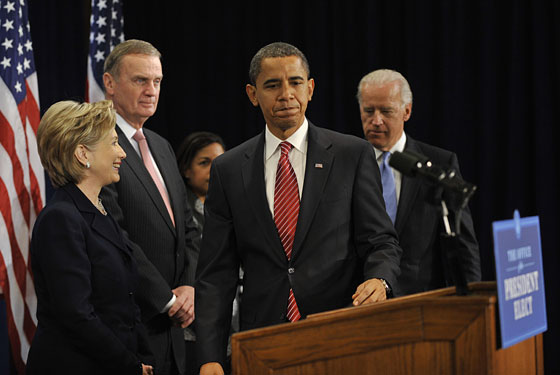
President-Elect Obama's New National Secuirty Team -- Opinions, Editorials, And Commentaries

Barack Obama (right), flanked by Vice-President elect Joseph Biden (2nd-right)
holds a press conference (Photo AFP)

Obama Stresses Diplomacy With New National
Security Team -- L.A. Times


Reporting from Washington and Chicago -- President-elect Barack Obama on Monday introduced his national security team, made up of centrist Washington insiders, and promised an overhaul of foreign policy to give added emphasis to diplomacy and bring a "new dawn of American leadership."

Appearing at a Chicago news conference with secretary of State nominee Sen. Hillary Rodham Clinton and five others whom he plans to put on his team, Obama said his administration would restore U.S. standing in the world through alliance-building and international institutions, as well as by maintaining American military might.

Read more ....

More Opinions, Editorials, And Commentaries

Mr. Obama’s Team -- New York Times editorial
Team of Centrists -- Washington Post editorial
Obama's National Security Balancing Act -- Christian Science Monitor editorial
Obama Names Team to Face A Complex Security Picture -- Washington Post
Mr. Obama’s Team -- New York Times
For the UN, a Clean Break -- Los Angeles Times editorial
Obama's National Security Team Aims for Foreign Policy Change -- Political Affairs
The 3 AM Team -- National Review editorial
Continuity We Can Believe In -- New York Times opinion
Terrorists Don't Wait -- Washington Post opinion
Barack Obama: Steady as She Goes -- National Review opinion
Praise For Obama's National Security Team -- U.S. News And World Report
A Team of Whizzes -- New York Times opinion
Pinch Me, Am I Dreaming? -- National Review opinion