Showing posts with label gulf war. Show all posts

Sunday, February 28, 2016

Remembering The Last Great Tank Battle


We Are The Mighty: ‘The last great tank battle’ was a slugfest of epic proportions

The men of the 2nd Armored Cavalry Regiment spearheaded one of the American columns that invaded Iraq on Feb. 23, 1991. After three days of light fighting they stumbled into one of the largest Iraqi armored formations and annihilated it with cannons, TOW missiles and mortars in the Battle of 73 Easting, often called “the last great tank battle of the 20th century.”

Then-Capt. (now Lt. Gen.) H.R. McMaster, commander of Eagle Troop, 2nd Squadron, 2nd ACR, literally wrote the book on the battle and commanded one of the lead elements in the fight.

Helicopters buzzed over Eagle Troop as the ground invasion of Iraq began on Feb. 23. The mission of the 2nd ACR was simple in theory but would be challenging to achieve. They were to cut off Iraqi retreat routes out of Kuwait and destroy the large armored formations thought to be hiding in the flat, featureless desert.

Read more ....

WNU Editor: M1 tanks vs T-72s .... not a fair fight. Then-Capt. H.R. McMaster is now a Lt. General.

Monday, February 22, 2016

Revisiting The First Gulf War


James A Warren, Daily Beast: The Gulf War Victory That Never Was

When US-led coalition forces drove Saddam Hussein out of Kuwait, the campaign was heralded as the antidote to Vietnam. A quarter century later it looks a lot less impressive.

On August 2, 1990, Saddam Hussein, notorious Iraqi strongman, triggered the first great international crisis of the post-Cold War era by invading Kuwait and declaring it Iraq’s nineteenth province. With Kuwait in his back pocket and the fourth largest army in the world at his disposal, Saddam effectively controlled two-thirds of the earth’s oil reserves, and had every hope of establishing Iraq as the dominant power in the region.

As the Iraqi military build-up continued apace in Kuwait, fears of an invasion of Saudi Arabia mounted. On August 6, George Bush declared, “This will not stand, this aggression of Kuwait,” and he meant it. Quickly the American president obtained UN Security Council resolutions condemning the attack, imposing an embargo on Iraq, and seizing its foreign assets.

Read more ....

WNU Editor: From my point of view the first Gulf War was a success. It had a clear military mission, and with massive public and international support .... a commitment to the fight. The problem was (and is) after the fighting had stopped, and the analysis and policies that were implemented. This was a political and foreign establishment decision .... and one that we are unfortunately paying for to this day.

Sunday, January 17, 2016

25 Years Ago The Gulf War Started


Jeffrey D. McCausland, War On The Rocks: The Gulf War's Anniversary: Reflections on the 25 Years Of U.S. Military Involvement In the Middle East

The field telephone alongside my cot rang at 0230 on January 17, 1991. I was a U.S. Army battalion commander in the desert of northern Saudi Arabia. My battalion had arrived from Germany in mid-December and deployed swiftly to within a few miles of the Iraqi border. The call was from my brigade commander summoning me to a meeting where I would learn that the long anticipated air campaign had commenced. Operation Desert Shield was over. Operation Desert Storm was on. The war had begun.

Today is the 25th anniversary of the Gulf War — the beginning of direct, major U.S. military involvement in the Middle East. This was also the moment when the region’s existing political order began to unravel, increasingly replaced by ethnic and religious sectarianism. On February 24, we invaded Iraq and over the course of 100 hours routed the Iraqi army and liberated Kuwait. My soldiers finished the war astride the so-called Highway of Death that connects Kuwait City to Basra. The road was littered with destroyed military and civilian vehicles illuminated by the gigantic oil fires ignited by the retreating Iraqi army. As we congratulated ourselves on our success, no American could have imagined that Iraq and the broader Middle East would be a focal point of U.S. national security policy for the next three decades.

Read more ....

WNU Editor: I was working for the United Nations in Montreal (ICAO) at the time. I first learned about the war breaking out from an American diplomat who told me as we were leaving the UN building that the war was going to start that evening. I turned around and went straight to my delegation office to pass the news .... but they already knew. An hour and a half later .... the news reports started to come in that Baghdad was being bombed. 25 years later .... wow .... who would have predicted the world that we live in today .... and where the Middle East is right now.

Saturday, January 29, 2011

What Was Key To the Success Of The First Gulf War?


Technology And Training Keys To Gulf War Success -- Houston Chronicle

Theodore Roosevelt often said leading his beloved cavalry troopers up the San Juan Heights was his "crowded hour" — the great moment of a life filled with remarkable achievements.

In the two decades that have passed since the Gulf War, I have come to know exactly what the old Rough Rider was talking about.

In August 1990, I was a second lieutenant commanding a team of artillery forward observers and mortar infantrymen when my unit, the 3rd Armored Cavalry Regiment, received orders for deployment to Saudi Arabia.

To be honest, like TR at the outset of the Spanish-American War, I was exhilarated by the news.

Read more ....

My Comment:
I agree. The Iraqi Army was outmatched everywhere.

Hat Tip: Prairie Pundit

Monday, January 17, 2011

Remembering The Start Of The Gulf War 20 Years Ago

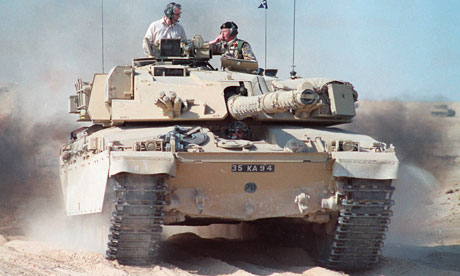
The-then prime minister, John Major, riding on a tank of the 4th Armoured Brigade (Desert Rats) while visiting British troops in the Gulf in January 1991, before the start of Operation Desert Storm against Iraq. Photograph: Reuters

Tensions Remain, 20 Years After Gulf War -- CNN

Baghdad (CNN) -- Twenty years after the United States and its allies launched Operation Desert Storm to roll back Saddam Hussein's invasion of Kuwait, Iraq still owes its smaller neighbor billions in reparations and more than 1,000 people are still missing.

It was in August 1990 that Iraq invaded, declaring that Kuwait was its 19th province. The United States led a counteroffensive starting January 16, 1991.

While the era of Saddam Hussein is now part of history, the impact of the invasion he ordered is anything but.

Read more ....

More News On The 20th Anniversary Of The Gulf War

A Day That Shook The World: Operation Desert Storm -- The Independent
Gulf war, 20 years on: memories of Desert Storm -- The Guardian
Military doctrine, now forgotten, critical to Gulf War -- AFP
Gulf war, 20 years on: Kuwait emerges from under Iraq's shadow -- The Guardian
1991 Gulf war 'a measure of last resort' -- BBC
Desert Storm changed Kuwait, military and journalism -- Korea Times
20th anniversary of Gulf War: Veterans recall the fight -- Fay Observer
Iraqis choose to forget, 20 years after Gulf war -- Mb.com.ph
Bush, Quayle Host Desert Storm 20th Reunion -- US News And World Report