Showing posts with label military history. Show all posts

Saturday, September 23, 2017

The First Drone Strike Was In 1944, And It Was Against The Japanese


Popular Mechanics: The Forgotten Drone of WWII

The TDR-1 was decades ahead of its time.

Conventional wisdom has that the proliferation of American remote-controlled warfare is a product of the post-9/11 era. While it's true that Predator and Reaper drones capable of dropping laser or satellite guided bombs have come into their own in that time, America's first drone bombers took to the skies much earlier than that—in 1944 to be precise.

In the early years of World War II, desperate for any technological advantage it could use on the battlefield, the U.S. military funded all sorts of unusual projects using new, untested technologies. The atomic bomb is one example. Another was essentially World War II's equivalent of a Reaper drone. The U.S. Navy paid the Interstate Aircraft Company to develop a remote-controlled bomber that could carry a 1,000 pound bomb or torpedo.

Read more ....

WNU Editor: What is amazing is that this drone strike worked (albeit 3 drones crashed while attempting it).

Tuesday, December 27, 2016

The 6 Most Powerful Armies of All Time

Reddit

Zachary Keck, Scout Warrior: 6 Most Powerful Armies of All Time

Armies are the most important factor in assessing the relative power of a nation. But how do we judge which armies were the most powerful in their time?

n an anarchical system like international relations, military power is the ultimate form of currency. A state may have all the culture, art, philosophy, and glitter and glory in the world, but it’s all for naught if the country doesn’t have a powerful military to defend itself. Mao Zedong put it [4] bluntly when he stated: “power grows out of the barrel of a gun.”

Of all the types of military power, armies are arguably the most important for the simple fact that people live on land, and are likely to continue doing so in the future. As the famous political scientist John J. Mearsheimer has noted [5]: “Armies, along with their supporting air and naval forces, are the paramount form of military power in the modern world.”

Read more ....

WNU Editor: I would also include the army under Alexander The Great.

Saturday, December 15, 2012

Who Really Defeated Napoleon?

"Napoleon's Retreat from Moscow". Painting by Adolph Northen/Wiki Commons.

Napoleon Wasn’t Defeated By The Russians -- Joe Knight, Slate

Tchaikovsky’s 1812 Overture gives too much credit to cannons.

History has taught us that Napoleon, in his invasion of Russia in 1812, marched into Moscow with his army largely intact and retreated only because the citizens of Moscow burned three-fourths of the city, depriving the army of food and supplies. The harsh Russian winter then devastated the army as it retreated. The Russians’ victory, commemorated by Tchaikovsky’s 1812 Overture, was one of the great upsets of military history.

But no one recognized the truly great power in this war.

Read more ....

My Comment
: Had to learn this in Russian school .... but it is true that disease, winter, partisan actions, and running out of food is what destroyed the French army .... and this was the Russian strategy.

Saturday, January 3, 2009

CIA Transitions Past: Jimmy Carter's Frosty Meeting With Spy Chief Bush

Former Presidents George H. W. Bush, Jimmy Carter, Bill Clinton

From CQ Politics/Spytalk:

In light of CIA Director Michael V. Hayden's virtual plea to be kept on in the Obama administration, it's interesting to look back at a similar instance in 1976, when George H.W. Bush tried to get President-elect Jimmy Carter to retain him as his spy chief.

Carter loved the CIA briefings he had been getting during his campaign against President Gerald R. Ford, according to the agency's official history of presidential transitions.

Sometimes the sessions, which usually took place at his modest home in Plains, Ga., went on for six hours.

"Carter was a very careful and interested listener and an active participant," writes longtime CIA official John L. Helgerson, the study's author.

"All who were present remember that he asked a great many questions, often in minute detail. He was especially interested in the nature of the Intelligence Community's evidence, including satellite photography of deployed Soviet weapons."

Read more ....

Monday, December 22, 2008

General George S. Patton Was Assassinated To Silence His Criticism Of Allied War Leaders Claims New Book

'We've got a terrible situation with this great patriot, he's out of control and we must save him from himself'. The OSS head General did not trust Patton

From The Telegraph:

George S. Patton, America's greatest combat general of the Second World War, was assassinated after the conflict with the connivance of US leaders, according to a new book.

The newly unearthed diaries of a colourful assassin for the wartime Office of Strategic Services (OSS), the forerunner of the CIA, reveal that American spy chiefs wanted Patton dead because he was threatening to expose allied collusion with the Russians that cost American lives.

The death of General Patton in December 1945, is one of the enduring mysteries of the war era. Although he had suffered serious injuries in a car crash in Manheim, he was thought to be recovering and was on the verge of flying home.

But after a decade-long investigation, military historian Robert Wilcox claims that OSS head General "Wild Bill" Donovan ordered a highly decorated marksman called Douglas Bazata to silence Patton, who gloried in the nickname "Old Blood and Guts".

Read more ....

Monday, November 24, 2008

How Warfare Shaped Human Evolution

Iran - Iraq War

From The New Scientist:

IT'S a question at the heart of what it is to be human: why do we go to war? The cost to human society is enormous, yet for all our intellectual development, we continue to wage war well into the 21st century.

Now a new theory is emerging that challenges the prevailing view that warfare is a product of human culture and thus a relatively recent phenomenon. For the first time, anthropologists, archaeologists, primatologists, psychologists and political scientists are approaching a consensus. Not only is war as ancient as humankind, they say, but it has played an integral role in our evolution.

The theory helps explain the evolution of familiar aspects of warlike behaviour such as gang warfare. And even suggests the cooperative skills we've had to develop to be effective warriors have turned into the modern ability to work towards a common goal.

Read more ....

Monday, November 17, 2008

The Cold War's Missing Atom Bombs

During the height of the Cold War US B-52 bombers carrying nuclear bombs were in the air around the clock, 365 days a year. Officially 11 bombs went missing but it is estimated that 50 were lost. (Photo Der Spiegel)

From Der Spiegel:

In a 1968 plane crash, the US military lost an atom bomb in Greenland's Arctic ice. But this was no isolated case. Up to 50 nuclear warheads are believed to have gone missing during the Cold War, and not all of them are in unpopulated areas.

It was a little early to be swimming in the Mediterranean that year. But in early March 1966, Manuel Fraga Iribarne, the Spanish information minister at the time, and Biddle Duke, the American ambassador in Madrid, together with their respective families, plunged into the chilly waters off the Costa Cálida. Journalists from around the world had gathered on the beach of the small village of Palomares to report on the two families' spring bathing outing. Their interest would have been surprising, if it hadn't been for the hydrogen bomb lying on the ocean floor only a few kilometers away, a bomb with more than 1,000 times the explosive force of the one that flattened Hiroshima.

Read more ....

My Comment:I can understand unexploded ordinance on a battlefield .... but this piece of ordinance is not a normal piece of ordinance. I can only hope that all of the components were retrieved.

Sunday, November 9, 2008

The Dirty Dozen

U.S. Army Honors Unit That Inspired "The Dirty Dozen" -- Market Watch

WASHINGTON, Nov 07, 2008 (BUSINESS WIRE) -- Paratroopers of the 101st Airborne Division's most dangerous unit were officially thanked today at the American Veterans Center's 11th Annual Conference by the Army's Freedom Team Salute program.

The Veterans of the 101st captured a bridge on D-Day, parachuted into Bastogne during the Battle of the Bulge, and inspired the movie "The Dirty Dozen". They were the Filthy Thirteen, the demolitions unit of the 101st, whose soldiers later became pathfinders and jumped into Bastogne, where they provided a surrounded division with communications equipment that enabled planes to drop supplies. Led by Jake McNiece, the Filthy Thirteen were notorious on and off the battlefield. They played hard and hated saluting and drill.

Read more ....

My Comment: These are the men who made and make America great ....

Tuesday, October 7, 2008

The Memphis Belle -- Coming Back To Life

After 25 missions, the crew and the Belle went on a War Bonds tour, stopping at Patterson Field in Ohio. Recalling the tour decades later, Commander Robert Morgan wrote: "In today's lingo, our uniforms were dazzling 'chick magnets.'" (Photo: USAF)

Restoration: The Memphis Belle -- Air And Space Magazine

For this famous B-17, surviving 25 missions in World War II was the easy part.

Two years ago, Roger Deere traveled to an eastern Ohio coal town, where he visited a four-room Sears pre-fabricated house whose ceiling bowed down from the weight of all the stuff in the attic. The homeowner had died; a relative poking through the accumulation had run across something he thought might be of interest to Deere. Along with everything else, the attic contained the radio equipment for a B-17 bomber.

Deere did not ask how radio equipment got into the attic. He did not want an explanation; he wanted the equipment.

In time, it will be placed in the Memphis Belle, a Boeing B-17F Flying Fortress now being restored at the National Museum of the U.S. Air Force in Dayton, Ohio, where Deere is the chief of the restoration division.

During World War II, the U.S. Army Air Forces required heavy-bomber crews to complete 25 missions before they could go home. In 1943, having flown over France, Belgium, and Germany, the Memphis Belle crew became one of the first to reach that goal. After returning to the States in June 1943, the bomber and many of its crew served as the centerpiece of a 31-city War Bonds tour. Academy Award-winning director William Wyler documented the Belle’s service in a 41-minute color film (viewable online at the Internet Archive). The four-engine bomber became the most famous aircraft from the air war in Europe.

Read more ....

Sunday, September 14, 2008

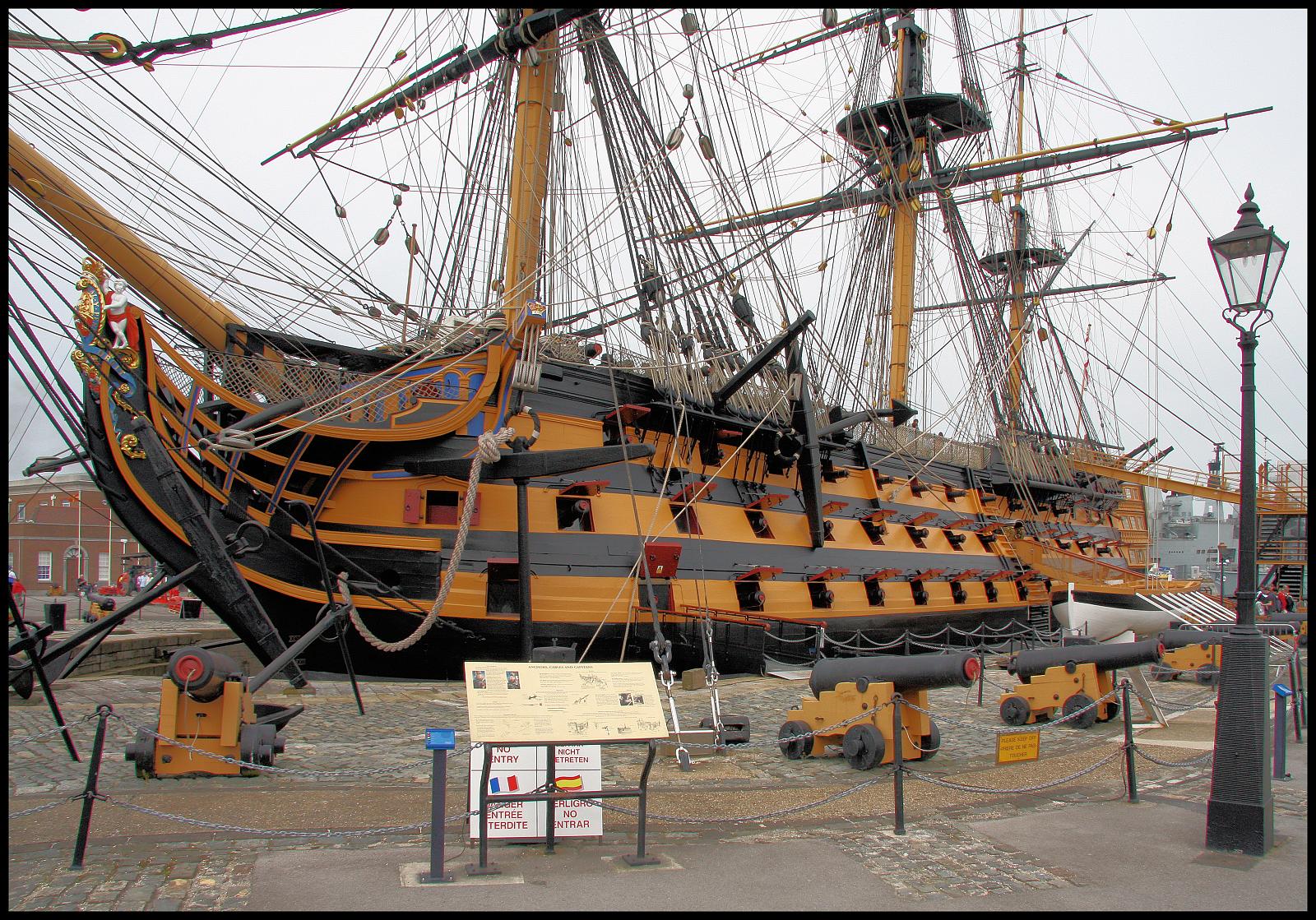
The Royal Navy May Hand Over Nelson’s Flagship To A Charity

(Click the Picture to Enlarge)
Admiral Lord Nelson's Flagship HMS Victory - 1765

From The Times Online:

The Royal Navy may hand over HMS Victory, Nelson’s flagship on which he met his death at the Battle of Trafalgar, to a charity or a government department.

They are among options being considered to take over the cost of £1.5 million a year to run the world’s only 18th-century “ship of the line” – one that took a direct part in sea battles. Some 500,000 people a year visit the vessel in dry dock at Portsmouth.

The range of options that the Ministry of Defence is putting out for consultation are leaving the Victory with the Navy, public ownership by another government department or public body, setting up a new charity for the ship or using an existing one.

Baroness Taylor of Bolton, a Defence minister, said that the ship needed “extensive works” to ensure its preservation for generations to come.

Vice-Admiral Alan Massey, the Second Sea Lord, said that the Victory was “a vital part of our heritage” and that the MoD was committed to securing her future.

My Comment: Lord Nelson just turned in his grave.