Showing posts with label weapon systems. Show all posts

Saturday, November 21, 2020

This New High-Definition Thermal Sensor Makes All US Weapon Systems More Lethal

Reuters National Interest: The F-35 Destroyed the Enemy in a Recent Wargame Thanks to One Thing

BAE developers say the Athena 1920, now beginning full volume production, brings targeting systems a degree of full high-definition resolution with a field of view able to replace up to seven or eight individual cameras. 

Apache helicopters, Army tanks, drones, surveillance planes and targeting systems need to find and destroy enemy targets otherwise hidden or obscured from view. Ideally, the military would find targets at very long ranges and with great image fidelity. This would allow Army units to expedite the kill chain and destroy enemies before they are themselves detected. For this kind of mission, infrared sensors and various applications of thermal imaging continue to prove indispensable to the majority of U.S. weapons systems, including small arms, anti-tank missiles, fighter jets and overhead drones, among much more. 


WNU Editor: For more information on the Athena 1920, go here .... BAE Systems unveils high-definition, uncooled thermal sensor (Optics.org)

Friday, February 24, 2017

The U.S. Navy Has Figured A Way To Use Cheaper 'Dumb Bombs' Over Expensive Missiles

Aviation Ordnanceman 3rd Class Shirley Shugar, from Joppa, Ala., takes inventory of ordnance in the bomb farm aboard the aircraft carrier USS Ronald Reagan (CVN 76). The Ronald Reagan Carrier Strike Group is underway continuing training before deploying to the western Pacific Ocean and U.S. Central Command area of responsibility. US Navy photo by Mass Communication Specialist Seaman Nicholas A. Groesch

Business Insider: The US Navy may have just figured out a way to save billions on bombs

The US Navy may have come across a common sense way to save billions on bombs, according to statements made from US officials at the AFCEA West 2017 conference.

For years now, the Navy has been working on the Naval Integrated Fire Control-Counter Air (NIFC-CA) network to help detect, track, and intercept targets using a fused network of all types of sensors at the Navy's disposal.

Read more ....

Update:
NIFC-CA Advances Could Allow The Navy To Use Cheaper ‘Dumb’ Weapons (USNI News)

WNU Editor: Yup .... bombs are not cheap.

Thursday, July 31, 2014

Knowing How To Launch A BUK Missile Is Apparently Not That Hard

Russian 9K37 BUK air defense system in 2010. WIKIMEDIA Commons

Need To Learn To Launch A BUK Missile Quick? Look Online. -- Robert Beckhusen, Reuters

No one has admitted responsibility for firing the sophisticated missile that brought down Malaysia Airlines Flight 17, killing 298 people over Ukraine on July 17. But untrained rebels could probably have done it with a little practice. There are even instructions online, making it possible for nearly anyone who comes into possession of one of these systems — anywhere in the world — to use it.

Washington and Kiev both blame Russian-backed separatists from the self-proclaimed Donetsk People’s Republic for attacking the plane with a 9k37 BUK missile system. These rebels had bragged about possessing the weapon before the attack.

The BUK is in the upper tier of the world’s antiaircraft weapons. It’s considerably more advanced and has more complicated procedures to fire than point-and-shoot, shoulder-fired missiles. Its missiles can climb to an altitude of 46,000 feet at Mach 3 speeds, packing more than a 154-pound high-explosive warhead.

Read more ....

My Comment: I have been told that the BUK system also has launch code protections .... was this a problem for the crew who launched this missile to take down MH17 .... apparently not.

Tuesday, April 30, 2013

U.S. Navy To Deploy Rail Guns And Lasers


Navy Set To Deploy Rail Guns, Laser Prototypes -- DoD Buzz

The U.S. Navy’s Science and Technology community is deploying prototypes of electromagnetic rail guns, solid-state laser weapons and underwater unmanned vehicles in operational units with sailors and Marines, senior service leaders said April.

“These prototypes are shifting the game in our favor. We can no longer spend huge dollars on systems — they must be very reliable, very affordable and very effective. It is about developing disruptive technologies that can be hugely effective and hugely affordable,” Rear Adm. Matthew L. Klunder, Chief of Naval Research, Office of Naval Research (ONR), said at the National Defense Industrial Association’s 14th Annual Science & Engineering Technology Conference/Defense Tech Exposition, National Harbor, Md.

Read more ....

My Comment: The above two videos describe both U.S. Navy weapon systems.

Saturday, April 21, 2012

Flame Thrower History (Video)


WNU Editor: He gives a great lecture .... but he does not use the flame thrower in this video clip. If you want to see the flame thrower in operation .... go here.

Saturday, January 28, 2012

Pentagon Needs A Bigger Bomb

MOP dropped from a B-52 Stratofortress (Boeing)

Pentagon Seeks Mightier Bomb vs. Iran -- Wall Street Journal

WASHINGTON—Pentagon war planners have concluded that their largest conventional bomb isn't yet capable of destroying Iran's most heavily fortified underground facilities, and are stepping up efforts to make it more powerful, according to U.S. officials briefed on the plan.

The 30,000-pound "bunker-buster" bomb, known as the Massive Ordnance Penetrator, was specifically designed to take out the hardened fortifications built by Iran and North Korea to cloak their nuclear programs.

But initial tests indicated that the bomb, as currently configured, wouldn't be capable of destroying some of Iran's facilities, either because of their depth or because Tehran has added new fortifications to protect them.

Read more
....

Update #1: US seeks more powerful bomb to combat Iran's underground facilities -- FOX News
Update #2: US incapable of destroying some Iran nuke facilities -- Jerusalem Post

My Comment: Considering how deep Iran's bunkers are .... the Pentagon will definitely need a more powerful bomb.

Saturday, January 21, 2012

30,000-lb Massive Ordnance Penetrator Bomb Earns A Rare Honor

MOP dropped from a B-52 Stratofortress (Boeing)

The 30,000-lb Massive Ordnance Penetrator Bomb Works So Well It Earned A Rare Honor -- Business Insider

To achieve its goal of blasting through 60 feet of concrete with a bomb exploding at 200 feet underground, Boeing's Massive Ordnance Penetrator (MOP) team just won a prestigious prize.

The group's recognition with the William J. Perry award was delivered by the Precision Strike Association to honor "one of the Secretary of Defense's number one weapons programs."

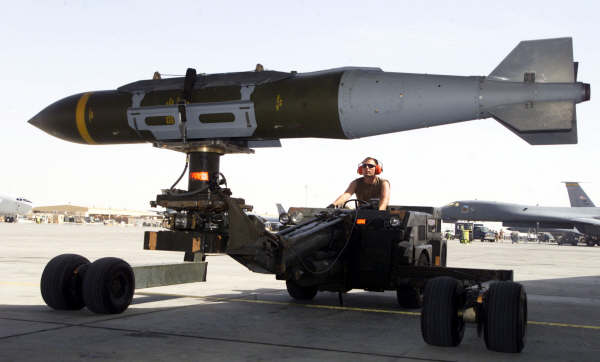
At over 20 feet in length and weighing 30,000 pounds, the MOP is a precision guided bomb whose first successful test in 2007 led to an Air Force order for eight more worth $28 million in April 2011.

Read more
....

My Comment:
The following video explains this weapon system in more detail.

Thursday, January 5, 2012

Military’s Freakiest ‘Non-Lethal’ Weapon Ideas

Images: U.S. Army; JNLWD

Exposed: The Military’s Freakiest ‘Non-Lethal’ Weapon Ideas -- Danger Room

Tasers that elicit excruciating spasms in one person at a time? Foam pellets that send an entire crowd fleeing in agony? Pfft. So 2011. Where non-lethal weapons are concerned, the future’s all about sonic microwaves that can make swimmers puke mid-stroke, and aircraft with laser beams that can redirect an entire enemy plane mid-flight.

Or, at least, those are the deepest, darkest wishes of the Pentagon agency responsible for non-lethal weapons.

Read more ....

Update: U.S. Non-Lethal Weapon Work Revealed -- Ares/Aviation Week

My Comment: These weapon systems may be 'non-lethal' .... but they hurt like hell.

Tuesday, October 18, 2011

Kamikaze' Drones To Be Included In The US Army's Arsenal

Designed as a tube launched weapon, the Switchblade system comprises a miniature air vehicle that launches from a small tube that can be carried in a backpack and operated by a single soldier. Flying quietly at high speed the Switchblade delivers its onboard explosive payload with precision while minimizing collateral damage. Photo: Aerovironment

US Army To Fly 'Kamikaze' Drones' -- Breitbart/AFP

A miniature "kamikaze" drone designed to quietly hover in the sky before dive-bombing and slamming into a human target will soon be part of the US Army's arsenal, officials say.

Dubbed the "Switchblade," the robotic aircraft represents the latest attempt by the United States to refine how it takes out suspected militants.

Weighing less than two kilos, the drone is small enough to fit into a soldier's backpack and is launched from a tube, with wings quickly folding out as it soars into the air, according to manufacturer AeroVironment.

Read more
....

My Comment: This is actually old news. Go here for more info.

Friday, September 2, 2011

The Growing Popularity Of Small Airborne Weapon Systems

Designed as a tube launched weapon, the Switchblade system comprises a miniature air vehicle that launches from a small tube that can be carried in a backpack and operated by a single soldier. Flying quietly at high speed the Switchblade delivers its onboard explosive payload with precision while minimizing collateral damage. Photo: Aerovironment

U.S. Army Buys Switchblade Small Loitering Weapons -- Defense Update

The U.S. Army has awarded AeroVironment a contract worth almost $5 million for the first deliveries of Switchblade agile munition, the company announced today. The contract was awarded two month ago, on June 29, 2011, culminating a selection process for a loitering light weight munition.

The procurement is part of the Army’s rapid fielding initiative. The U.S. Army Close Combat Weapons Systems (CCWS), Program Executive Office Missiles and Space (PEO MS) is the awarding office. The prototype Switchblade system previously received Safety Confirmation and underwent Military Utility Assessment with the U.S. Army in the fall of 2010.

Read more ....

More News On The Switchblade Agile Munition System

US Army Brings a Switchblade to A Gun Fight -- Defense Industry Daily
AeroVironment wins $4.9 million U.S. Army contract to provide Switchblade agile munition operational systems, engineering services -- Avionics
AeroVironment wins $4.9m US Army contract -- Shephard
U.S. Army Awards AeroVironment $4.9 Million Contract for Switchblade Agile Munition Systems and Services -- Market Watch
AeroVironment Gets Order For Lethal Backpack UAV -- Ares/Aviation Week

Tuesday, July 13, 2010

"Terminator" Machine-Gun Robots Deployed On DMZ

A set of SGR-1 armed robots have been set up near the southern boundary of Korea's Demilitarized Zone on an experimental basis to see how well they complement the soldiers that keep an eye on the heavily fortified border between the North and South. The robot, using heat and motion detectors, can identify and shoot a potential target more than two miles away. Photo courtesy of Samsung Techwi

Machine-Gun-Toting Robots Deployed On DMZ -- Stars And Stripes

DEMILITARIZED ZONE, Korea — Security along the DMZ has gone high-tech, as South Korea has quietly installed a number of machine-gun-armed robots to serve as the first line of defense against the potential advance of North Korean soldiers.

The stationary robots — which look like a cross between a traffic signal and a tourist-trap telescope — are more drone than Terminator in concept, operated remotely just outside the southern boundary of the DMZ by humans in a nearby command center.

Read more ....

Update: South Korea deploys robot capable of killing intruders along border with North -- The Telegraph

My Comment: What was once science fiction .... is now nothing new.

Tuesday, January 5, 2010

10 Sci-Fi Weapons That Actually Exist

Behold the Laser Avenger, a cannon that could be used to take down incoming aircraft. Boeing was able to shoot a drone out of the sky with the hummer-mounted laser, even though it’s not particularly high-powered. It cooked the remote-controlled aircraft using a somewhat feeble 1-kilowatt beam. More recently, the company shot down another UAV using a low-power laser paired with its Mobile Active Targeting Resource for Integrated eXperiments, or Matrix, system during a test in White Sands, New Mexico.

From The Danger Room:

Sure, the gear may look like it came straight out of Avatar or Battlestar Galactica. But all of the laser weapons, robots, sonic blasters and puke rays pictured here are real. Some of these weapons have already found their way onto the battlefield. If the rest of this sci-fi arsenal follows, war may soon be unrecognizable.

Read on for a look at some of these futuristic weapons being tested today.

Read more ....

Monday, April 20, 2009

Apple’s New Weapon

From Newsweek:

To help soldiers make sense of data from drones, satellites and ground sensors, the U.S. military now issues the iPod Touch.

Tying the hands of a person who is speaking, the Arab proverb goes, is akin to "tying his tongue." Western soldiers in Iraq know how important gestures can be when communicating with locals. To close, open and close a fist means "light," but just opening a fist means "bomb." One soldier recently home from Iraq once tried to order an Iraqi man to lie down. To get his point across, the soldier had to demonstrate by stretching out in the dirt. Translation software could help, but what's the best way to make it available in the field?

Read more ....

Tuesday, April 14, 2009

97 Percent Fewer Bombs Being Dropped


From Strategy Page:

Smart bombs have led to far fewer bombs being dropped. This has led to many changes in the way wars are fought. Keep in mind that during the peak six years of the Vietnam war, 6.7 million tons of bombs were dropped. That was the same rate they were dropped during the major bombing campaigns of World War II. But in eight years of fighting in Afghanistan and Iraq, only 42,000 tons have been dropped. Thus, while in the past, a million tons were dropped a year, for the war on terror, less than 6,000 tons a year were dropped. That means a reduction of over 99 percent. Even when you adjust for the different number of U.S. troops involved, that's still over 97 percent fewer bombs dropped.

Read more ....

My Comment: These stats are surprising .... and that is an understatement.

Saturday, April 4, 2009

'Terrorists Could Bring Down Jumbo Jet Using Microwave Cannon Built Over Internet'

Deadly: Terrorists with the canon could cause a disaster like Lockerbie, above

From The Daily Mail:


A deadly 'microwave cannon' capable of bringing down aircraft can be built using information and parts available on the internet, a terrorism expert has warned.

The device would fire a high-energy electromagnetic pulse, frying the electronics of a plane as it comes in to land.

It raises the chilling prospect of attacks at transport hubs like Heathrow, capable of killing hundreds of people living in the flight paths.

Read more ....

Tuesday, January 20, 2009

What's Wrong With Weapons Acquisitions?

Stealthy and Steep: The US $137 million F-22, officially fielded in 2005, has yet to fly a mission in Iraq or Afghanistan. PHOTO: Wesley T. Kitten/Photoshelter

From IEEE Spectrum:

The Pentagon now spends about $21.6 million every hour to procure new military systems. As the cost and complexity of defense acquisitions programs continue to spiral out of control, many defense experts believe runaway military spending is unsustainable. Meanwhile, soldiers in the field are being denied much-need equipment, while civilian programs go unfunded. In this special report, IEEE Spectrum contributing editor Robert N. Charette examines the root causes of the current crisis in weapons acquisitions and what can be done to reform the system.

Read more ....

My Comment: An article that I slowly recommend everyone to read. I would not be surprised if this is a sign of things to come in the incoming Obama administration

Tuesday, December 30, 2008

The World's Deadliest Conventional Weapons

A Lockheed Martin AC-130H Hercules gunship aircraft from the 16th Special Operations Squadron out of Hurlburt Field, Fla., released jettisons flares as an infrared countermeasure during multi-gunship formation egress training Courtesy USAF (Photo from Flight Global)

From FOX News:

The five deadliest conventional weapons in the world are all part of the U.S. Armed Forces' arsenal, though many are used by other countries as well.

Some date back to World War II in concept, but they are still lethal and continue to be used in battle in Iraq and Afghanistan.

The fearsome five:

The AC-130 aerial gunship: This comes in two forms, the AC-130H "Spectre" and the more heavily armed AC-130U "Spooky," both flown by the U.S. Air Force. Versions of the AC-130 were first deployed during the Vietnam War.

It's designed to hit targets on the ground or at sea, firing Gatling guns and howitzers fore, aft and to the side. The AC-130's weakness is that it flies "low and slow," making it vulnerable to surface-to-air or air-to-air missiles.

Read more ....

My Comment: I would also add UAVs and other robotic weapon systems.

Sunday, November 2, 2008

The Taliban's Super Bombs


Taliban's New Super-Bombs Threaten U.S. Troops, Even in Pricey MRAPs -- U.S. World And News Report

GHAZNI, Afghanistan—Throughout Afghanistan, roadside bombs are increasing not only in number but also in size, with devastating consequences for U.S. troops and beleaguered Afghan truck drivers alike.

Culverts that run under the road to help drain and irrigate surrounding fields in the rural country now regularly conceal these powerful improvised explosive devices, or IEDs, with increasingly large charges. Roadside bombs that once weighed 10 to 20 pounds have morphed into multigallon drums packed with 200 to 500 pounds of explosives, which insurgents roll into culverts with wheelbarrows.

Read more ....

Monday, August 25, 2008

Tomorrows Weapon Systems Today

Army Buys More Accurate
Artillery Shells -- USA Today


WASHINGTON — The Army has accelerated purchasing a high-tech artillery shell that can be fired from as far away as 14 miles yet explode within 30 feet of its target to avoid civilian casualties in Iraq and Afghanistan, Army officials and analysts say.

An urgent request from commanders in Iraq for more accurate artillery to reduce civilian deaths prompted the Army to speed production of the Excalibur shells, according to the Government Accountability Office. In May, the Army awarded an $85 million contract to buy Excaliburs — the most ever spent for the shells.

Read more ....