Showing posts with label commentary -- foreign policy. Show all posts

Wednesday, December 27, 2023

Are The 'Guardrails' That Once Prevented Wars Failing?

Politico.eu: The guardrails that once prevented wars are failing  

Wars are no longer black-swan events. They are a regular occurrence, representing the most significant transformation in global affairs since 9/11. 

The Israel-Hamas war is an ominous message to the world: The guardrails that long stopped wars from breaking out are now effectively failing. 

Of course, Ukraine was the first sign of this. After Russia invaded the country, it quickly became the worst conflict in Europe since World War II. Except, at the onset, the world didn’t know what to make of it. Was this a “one-off” event or the start of something else? 

The latest flareup in the Middle East answers this question.  

Read more ....  

WNU Editor: I am old enough to remember that even during the height of the Cold War American and Soviet diplomats were always talking. This helped to not only stop ongoing wars at the time from escalating and spreading, but it also helped prevent wars from starting. No more now. The lines of communication have broken down with the election of the Biden administration, and I do not see any possibility of it coming back in the foreseeable future.

Friday, December 15, 2017

Professor Niall Ferguson’s Take On The Current Global Situation


Policy Exchange: Niall Ferguson compares balance of power to Congress of Vienna at Policy Exchange’s Anglo-American conference

Professor Niall Ferguson, who spoke at the launch of Policy Exchange’s new Anglo-American project, argued that the best historical analogy for the current balance of powers is with the pentarchy of five great powers that dominated European (and hence world) affairs for a century after the Congress of Vienna of 1814-15. A modern pentarchy was created in the form of the permanent members of the UN Security Council. Professor argues that “Whether or not these five great powers can make common cause once again is the great geopolitical question of our time.”

Professor Ferguson’s full remarks are given below:

Read more ....

WNU Editor: I love reading this stuff. Kudos to the Policy Exchange for making this happen .... New Anglo-American project launched with high-level conference in Washington (Policy Exchange).

Hat tip to Gabriel for the above link.

Monday, August 7, 2017

Are Foreign Diplomats Laughing At President Trump?

President Donald Trump. REUTERS/Carlos Barria

Business Insider: Foreign diplomats are laughing at Trump, but they're no closer to figuring him out

The consternation President Donald Trump has inspired in many Americans has perhaps been felt even more acutely by foreign diplomats, who have been trying to size up the American leader since he surged to the front of the crowded Republican primary field.

After the publication of full transcripts of Trump's calls with the leaders of Mexico and Australia, some of those diplomats were able to have a laugh at his expense.

But the details revealed by the transcripts may not give them any more insight into dealing with the mercurial US president.

Read more ....

WNU Editor: My read is different .... most of these diplomats in Washington are worried about their jobs, and their superiors back home are worried because their leaders are demanding intel on how to deal and negotiate with President Trump. What also does not help the situation is that many senior State Department positions have not been filled since the inauguration .... it is these officials who have in the past kept foreign diplomats in the loop on what was happening in Washington, and in turn these diplomats were able to inform their superiors back home on what was happening in the U.S.. For better or worse .... that chain of information has been broken, and no one knows when it will be back to "normal". Personally .... I like the chaos .... and to see these diplomats do something that they are not use to .... which is sweat a bit and worry that their political superiors are not happy with the little work that they are producing.

Wednesday, November 4, 2015

Can Tensions In The South China Sea Lead To War?


Wyatt Olson, Military.com/Stars and Stripes: Could Tensions in South China Sea Lead to Armed Confrontation?

China will likely ramp up its efforts to expand and militarize disputed islands in the South China Sea -- an area critical to the global economy -- as a result of the U.S. Navy’s more assertive patrols in the region, China experts say.

And while many analysts applaud the Navy’s more robust approach with so-called “freedom of navigation” operations, there’s little agreement about whether such patrols will lead to armed confrontation in the South China Sea, where more than $1.2 trillion in U.S. trade passes annually.

Some believe the relationship between the two nations, whose economies are deeply entwined, has matured to the point that dialogue will defuse tensions and potential conflict.

WNU Editor: A direct U.S. - China conflict .... no. But China's current relations with its neighbours are stressed, and there have already been instances where these countries have clashed (albeit without using weapons) in this dispute.

Friday, June 20, 2014

A Geopolitical Shift Away From The U.S.

Chinese President Xi Jinping and Russian President Vladimir Putin. © REUTERS/ Alexander Zemlianichenko/Pool

The New Great Power Triangle Tilt: China, Russia Vs. U.S. -- James Kitfield, Breaking Defense

WASHINGTON: The careful diplomatic stagecraft behind President Barack Obama’s recent European visit to celebrate the 70th anniversary of D-Day and to rally the Western alliance against Russia’s aggression in Ukraine was all but swept aside by strong new currents in geopolitics. While Obama talked tough in Poland to reassure NATO’s vulnerable eastern members, Russian President Vladimir Putin happily visited with his Western European friends who buy huge quantities of natural gas from him. French President Francois Hollande not only hosted Putin at a dinner, he refused to cancel a $1.6 billion sale of warships to Moscow.Meanwhile, as Putin and Hollande dined in comfort at the Elysee Palace, Russian special forces were supporting an offensive by pro-Russian rebels in eastern Ukraine that overran a key border control headquarters and threatened to open a land corridor between Russia and the recently annexed province of Crimea, home to Russia’s Black Sea Fleet.

Read more ....

My Comment: The Russian - Chinese "alliance" is more of an economic relationship .... not a military or political one .... and certainly not based on anti-Americanism. 

Wednesday, February 19, 2014

Should The U.S. Negotiate With The `Devil`?

The High Price Of Negotiating With Bad Guys -- Michael Rubin, Washington Post

It was during a 2007 Democratic primary debate that Sen. Barack Obama first declared “ridiculous” the idea that “not talking to countries is punishment to them.” Eighteen months later, with the world watching his historic inauguration, he reiterated his openness to dialogue with America’s enemies: “We will extend a hand if you are willing to unclench your fist.”

Since then, his administration has talked with North Korea and the Taliban, defied cynicism at home and abroad with efforts to jump-start ­Israeli-Palestinian talks , sought to bring Egypt’s Muslim Brotherhood in from the cold, and, after 35 years, brought the United States and Iran to the verge of a nuclear deal. And retired American diplomats Thomas Pickering and Rob Malley — as well as Rachel Schneller, a State Department official who was on leave at the time — have met with Hamas, a terrorist group implicated in scores of bombings and suicide attacks in Israel.

Read more ....

My Comment: I am skeptical that negotiating with an opponent who has not changed his fundamental beliefs and/or ideology would lead to a fruitful outcome. It is only when the other side has come to the realization that their goals can never be fulfilled and that a negotiated settlement will be in their interest is when progress is made .... and done usually very quickly. For this White House .... they are not focused on positioning the other side to realize that continuing a confrontation will result in their failure .... instead .... this White House is more focused on the process of bringing other parties to the table, and then hoping that their reasoning and persuasion will help change the other sides position.

So far .... this approach has been a failure. But instead of changing strategy .... the White House and Secretary of State John Kerry are now doubling down in their disputes with Iran, Syria, Russia, China, etc. .... and hoping that they will "change their ways". My prediction .... this is going to fail spectacularly, and the end result will be to embolden America`s enemies to be more demanding and more resilient in their efforts .... while ignoring our protestations and objections.

Thursday, January 2, 2014

What Will The Next 50 Years Be Like?


A Good Half-Century And A Bad One: What Will the Next 50 Years Be Like? -- Paul Wolfowitz, The American

The world today is more secure, prosperous, and free than it was 50 years ago, but an effective Western alliance is vital if we're going to sustain that progress.

This year we begin to commemorate a series of horrific centennials — anniversaries of one of the great catastrophes of modern history, World War I.

Looking back over the century that has passed since then, the world has changed remarkably. World War I was just the first of a series of calamities that made the next 50 years without any doubt the bloodiest half-century in human history.

And yet, the last half-century has been a very different story. The world today is more secure, prosperous, and free than it was 50 years ago.

In many ways, one could say that the challenge facing the world today is how to avoid the calamities of World War I and its aftermath and to continue the progress of the last 50 years. That very progress confronts us with new challenges, particularly the challenge of incorporating a new set of powerful countries into the international system. But even though many non-Western countries are becoming increasingly important and powerful, Western leadership is still critical in this new and more complicated world.

Read more ....

My Comment: I concur with Paul Wolfowitz's position that Western leadership is vital for the world to continue to progress on both the economic and political fronts .... but the costs involved in such an involvement are high .... and one has to wonder that at the end of the day .... did it make a difference and was it really worth it.

Friday, February 10, 2012

Can The State Department Learn From The Department Of Defense?

What Diplomats Can Learn From The Military -- Michael Rubin, Commentary

I’m spending the week in frigid Wiesbaden, where the V Corps is preparing to take over the mission in Afghanistan. As is often the case, there is much more learning outside the classroom than inside it. Indeed, there are few organizations in government as dedicated to learning as the U.S. military. The State Department may have its Foreign Service Institute where diplomats can take classes to prepare for new jobs, but in embassies and the State Department, learning does not occur on a day-to-day basis as it does in the military.

Read more ....

My Comment: The culture of the State Department is .... I suspect .... very different from the culture of the military .... and because of that they will not learn. But in all fairness .... the budget for the U.S. Department of Defense is wayyyy more than what the U.S. State Department's is, and their involvement (US Department of Defense) on the international scene usually entails an approach that we can say is .... not diplomatic.

Monday, June 6, 2011

Is Economic Power Replacing Military Might?

Has Economic Power Replaced Military Might? -- Joseph S. Nye, Project Syndicate

CAMBRIDGE – At the Cold War’s end, some pundits proclaimed that “geo-economics” had replaced geopolitics. Economic power would become the key to success in world politics, a change that many people thought would usher in a world dominated by Japan and Germany.

Today, some interpret the rise in China’s share of world output as signifying a fundamental shift in the balance of global power, but without considering military power. They argue that a dominant economic power soon becomes a dominant military power, forgetting that the United States was the world’s largest economy for 70 years before it became a military superpower.

Read more
....

My Comment: During the time of the Roman empire, it was Egypt that was the economic super power, providing grain and resources to all parts of the Roman Empire and beyond. But because of Rome's military reach and influence .... everyone said allegiance to Rome.

In the 21rst century .... China and Asia will probably be the dominant economic power .... but it is America that everyone not only looks at, but more importantly wants to live in .... the Chinese included.

Friday, April 29, 2011

How The Arab Spring Changed President Obama's Foreign Policy

Photo: Obama has said that his foreign-policy ideas defy traditional categories and ideologies. Photograph by Martin Schoeller.

The Consequentialist: How the Arab Spring remade Obama’s foreign policy. -- Ryan Lizza, The New Yorker

Barack Obama came to Washington just six years ago, having spent his professional life as a part-time lawyer, part-time law professor, and part-time state legislator in Illinois. As an undergraduate, he took courses in history and international relations, but neither his academic life nor his work in Springfield gave him an especially profound grasp of foreign affairs. As he coasted toward winning a seat in the U.S. Senate, in 2004, he began to reach out to a broad range of foreign-policy experts––politicians, diplomats, academics, and journalists.

Read more ....

My Comment: Charles Krauthammer has a rebuke to Ryan Lizza's article, and it is here. Ryan Lizza was also interviewed by Charlie Rose last night, and that discussion is here.

What is my take .... last night Ryan Lizza remarked how the term .... "leading from behind" .... is the best way to describe U.S. foreign policy, and that the phrase first came from South Africa's Mandela who embraced it and used it to convince South African authorities to change their way of governing. I cannot deny that, but where I differ from Ryan Lizza is that Mandela had a clear objective and ideology as well as a willing negotiator in South African President Frederik Willem de Klerk. President Obama does not have this clarity of purpose in his foreign policy (with the exception of being critical of past U.S. foreign policy decisions), nor does he have willing allies who will go to bat for him when he needs them. He is a solitary leader on the world stage, and when interests intersect is when other world leaders will talk to him. Charles Krauthammer's analysis is on the money .... and unfortunately for us .... this lack of vision, commitment, and purpose from the White House (and State Department) is severely hurting U.S. foreign policy .... a situation that almost every other country around the world is now taking notice.

Thursday, September 3, 2009

Afghanistan, Vietnam, And The Limits Of Force -- A Commentary

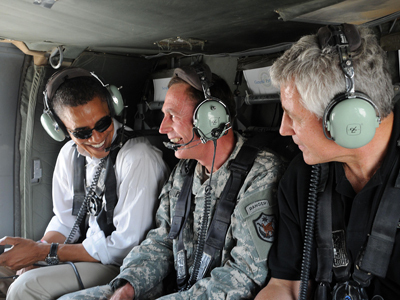
Senator Obama, General Petraeus, Senator Hagel (Baghdad, 2008)

From The Atlantic Council:

The other night I watched the film "The Deer Hunter." Afterward, I remembered why it took me so many years to be able to watch Vietnam movies.

It all came tumbling back -- the tragedy, the innocent victims, the waste. Too often in Washington we tend to see foreign policy as an abstraction, with little understanding of what we are committing our country to: the complications and consequences of endeavors. It is easy to get into war, not so easy to get out. Vietnam lasted more than 10 years; soon, we will slip into our ninth year in Afghanistan. We have been in Iraq for almost seven years.

Read more ....

My Comment: When I read this commentary, I said to myself that this is something that a Washington politician would write (as a rule, I always try my best to read the article first, check the author later).

No surprise, this commentary is written by Senator Chuck Hagel.

His prose and his thinking comes from a man who has been in the circle of power for a long time. His mindset is focused on history, tough decisions to make, consequences and responsibility. A man in government who once had to make tough decisions.

Sighhhh ..... and this is what is so wrong with Washington today.

The people who are best positioned to give people like Sen. Hagel the guidance and directions that they are looking for are from the American people themselves. With Vietnam .... which Sen. Hagel brings up on numerous occasions from the "men in power" point of view .... he should focus more on what the American people were thinking at the time .... and more importantly .... what they wanted.

But he does not .... his focus is on President Johnson .... and others like him. Limits of power .... consequences of actions .... responsibility for decisions .... limits for force .... legacy and ego all into play while denying that it is the case.

Senator Hagel is looking and searching for the making of a new world order, but what he should look and search for is what the American people want.

In a case like Afghanistan .... the direction that we should take is ridiculously simple. After 8 years of strong support for the Afghan war .... the American people (in six months) have lost confidence and trust in the war policy of this President .... and this support is dropping fast. They know that the time is to get out now .... that we tried our best but the Afghan conflict is a conflict that is best sorted by the Afghans themselves. President Obama is not going to deliver the silver bullet that will end this conflict .... the American people are coming to accept that .... time to move on.

Unfortunately .... Sen. Hagel is not listening .... and neither is President Obama. President Obama is positioning himself to be stuck in a conflict that has no strategic importance to the United States. It has now become political, and his ego will not accept the criticism that would come from his opponents if he becomes the President that lost Afghanistan to the Taliban and their Al Qaeda allies.

Hence .... because our politicians are not listening to us .... we are stuck in a region that has been a crossroads for man since the beginning of time .... fighting and dying for a piece of rock that many others throughout history have fought for and finally left when they realized that it had no value or importance to anyone but themselves.

Friday, May 1, 2009

What Is On The Foreign Policy Horizon For President Obama -- A Commentary


Acid Foreign Policy Test -- Washington Times

Battle in two states, and a one-state delusion.

The struggle in Afghanistan and Pakistan ("AfPak") is President Obama's most urgent foreign policy and national security priority.

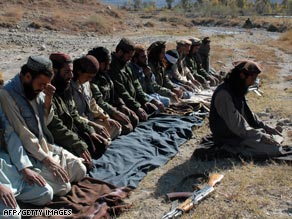
Taliban insurgents, with rocket-propelled grenades and AK-47s slung over their shoulders walk the streets of Peshawar, the capital of Pakistan's Northwest Frontier Province, unchallenged by police or army. The pro al Qaeda Taliban insurgency in Pakistan proper spread to within 60 miles of Islamabad, the capital of one of the world's eight nuclear powers. Pakistani helicopter gunships are now in action against homegrown guerrillas.

Read more ....

My Comment: A good review of what is probably going to happen on the foreign policy scene this year. I would only add the rise of Hezbollah to power in Lebanon and its impact on Israel, and how the economic crisis will further impact the economies of Europe and the U.S. The possibility of Iraq falling back into open sectarian warfare is a remote possibility .... but it is still a possibility.

Sunday, April 26, 2009

Contradictions In American Policy Towards Pakistan -- A Commentary

Suddenly -- Belmont Club

The Times Online says the administration is now pressing Islamabad to fight after its disastrous peace agreement with the Taliban in the NWFP inaugurated a pell-mell retreat. Secretary of State Clinton and senior diplomat Richard Holbrooke urged Pakistan not to abdicate to the Islamic extremists as they moved closer to the capital itself. Meanwhile, Bill Roggio, who has been warning against the peace deal with the Taliban from the beginning, notes that Pakistani Rangers have been deployed on the outskirts of Islamabad.

Hillary Clinton, the US Secretary of State, accused Pakistan this week of “abdicating to the Taleban”, which “poses a mortal threat to the security and safety of our country and the world”. … Mrs Clinton’s remarks followed a recent deal between Mr Zardari and the Taleban in the Swat Valley, allowing them to establish a fundamentalist enclave in the former tourist area in exchange for laying down their arms.

Read more ....

My Comment: An excellent summary and commentary on what is happening in Pakistan, and U.S. reaction to this turn of events.

Friday, February 6, 2009

Vice President Biden Is Right -- A Commentary

President Obama and Vice President Biden. (Photo from Javno)

Testing 1-2-3 -- Weekly Standard

Biden predicted Obama would be tested by our adversaries. He was right.


Yes. Joe Biden was right.

That's not a sentence we expect to type too often over the next four years, but it's proper to give credit where credit is due. And, on October 19, at a fundraiser in Seattle, the vice-presidential candidate explained:

And here's the point I want to make. Mark my words. Mark my words. It will not be six months before the world tests Barack Obama. .  .  . Remember I said it standing here if you don't remember anything else I said. Watch, we're gonna have an international crisis, a generated crisis, to test the mettle of this guy. .  .  . I can give you at least four or five scenarios from where it might originate. .  .  . They may emanate from the Middle East. They may emanate from the sub-continent. They may emanate from Russia's newly emboldened position.

Various unsavory characters do seem to have marked Biden's words.

The Iranian regime, having spent the first couple of weeks of Barack Obama's presidency preemptively scorning his overtures, mocking his weakness, and assuring the world its nuclear program is nonnegotiable, last Tuesday reported it had launched a satellite into orbit, making clear that Iran intends to have a missile launch capability on which to deploy its nuclear warheads.

Sounds like a test by the mullahs.

Read more ....

My Comment: The Vice President is right. The only surprise is that it is happening now .... not a few months from now.

With all of President Bush's faults, there was always a perception in the international community that people like Vice President Cheney, Secretary of Defense Rumsfeld, Secretary of State Colin Powell, and the scores of under secretaries, diplomats, and generals ... that as a group these men would insure the safety and protection of the American people and its allies.

The impact of 9/11, followed by the invasions of Afghanistan, later Iraq and then the war on terror .... these actions by these men dispelled any doubts on their will and resolve to fight and to win.

But these men and women are now gone .... replaced by a different group of men and women.

I wrote a few months ago that the world trouble makers will perceive the results of the American election as a decisive shift away from the past .... and I have been right so far. President Obama is no President Bush. Vice President Biden is no Cheney. Secretary of State Clinton is no Powell. Soon to be CIA Director Panetta is like .... well .... he is like no one else.

The military option is off the table, the intelligence war is off the table, and the will to use any of these resources is no longer there .... even in clear cut cases like Afghanistan and the war on terror, the willingness to follow-up on rhetoric and to use force is absent.

The results of this perception are now obvious .... a leadership vacuum is present on the world stage, and President Obama and his team are unsure of how to proceed. After spending years running for office, they are having trouble shifting gears to govern. This in turn has the potential to be disastrous in the short to medium term to both us and to our allies.

William Kristol in his Weekly Standard post outlines all of the trouble spots .... pop-quizzes before the real thing. The real test is going to happen in the next year to two .... with economic upheavals, oil, resource, and energy fluctuations impacting rogue states and their populations, coupled with the proliferation and distribution of WMDs .... the real test will come in 2010 and 2011 .... and from what I am seeing, team Obama is not ready.

Monday, December 8, 2008

Jones May Be Star Of Obama Foreign Policy Team -- A Commentary

From Bloomberg:

Last week, the world was taken by President-elect Barack Obama’s new foreign policy team: Hillary Clinton as U.S. secretary of State and Bob Gates, who is being kept on as head of the Defense Department.

Both choices are remarkable. There hasn’t been anything approaching the selection of Senator Clinton since 1980, when Ronald Reagan offered the vice presidency to old rival and ex- President Gerald Ford; in contrast, the Clinton appointment is probably a good idea.

Read more ....

Foggy Bottom Woes -- A Commentary

From Washington Times:

President-elect Barack Obama´s selection last week of Sen. Hillary Rodham Clinton as his secretary of state came as no surprise. After all, both camps were publicly wrestling for weeks in negotiations over what to do about everything from her husband´s secret fundraisers to key placements of her staff. I often found myself smirking at how much better President Bush was interacting with the incoming administration than the Clintons.

If the past is prologue, this selection has all the makings of a major executive headache for the Obama administration. Before the announcement was even made, the one overlooked for vice president was seeking assurances that she would have the kind of access to the president that she needs. Translated: When that phone rings at 3 a.m., even if I want to discuss the geopolitical impact of Belize, you better pick up! That statement would be funny if it weren´t so close to being accurate.

Read more ....